SMS deserves a core spot in your channel mix, but only with permission and real integration behind it. Text messages get read within minutes, drive purchases faster than most other channels, and reward brands that treat consent as non-negotiable. Your first move should be simple: capture proper opt-in and switch on an abandoned-cart SMS automation, since it targets the single biggest revenue leak in ecommerce.
- Sending targeted abandoned-cart SMS flows within 30 to 60 minutes can recover the majority of potential lost revenue from cart abandonment.
- List building requires explicit, documented consent through checkout opt-ins, on-site prompts, or in-store sign-ups, with clear separation between promotional and transactional consent.
- Automations like order updates, replenishment alerts, and VIP access are essential, but only effective when integrated with real-time order, inventory, and customer data.
- Personalization that references specific products or customer history boosts conversion rates, but over-personalization risks feeling invasive and should be carefully limited.
- Tracking key metrics such as click-through, conversion, revenue per message, and unsubscribe rate helps optimize campaigns and monitor performance over time.
Table of Contents
- Why SMS marketing works for ecommerce: the benefits and benchmarks
- What are the core SMS campaign types for ecommerce?
- How do you build an SMS list with proper consent?
- Which integrations and automations make SMS scale?
- How does personalisation improve SMS conversion rates?
- What KPIs and benchmarks should you track for SMS?
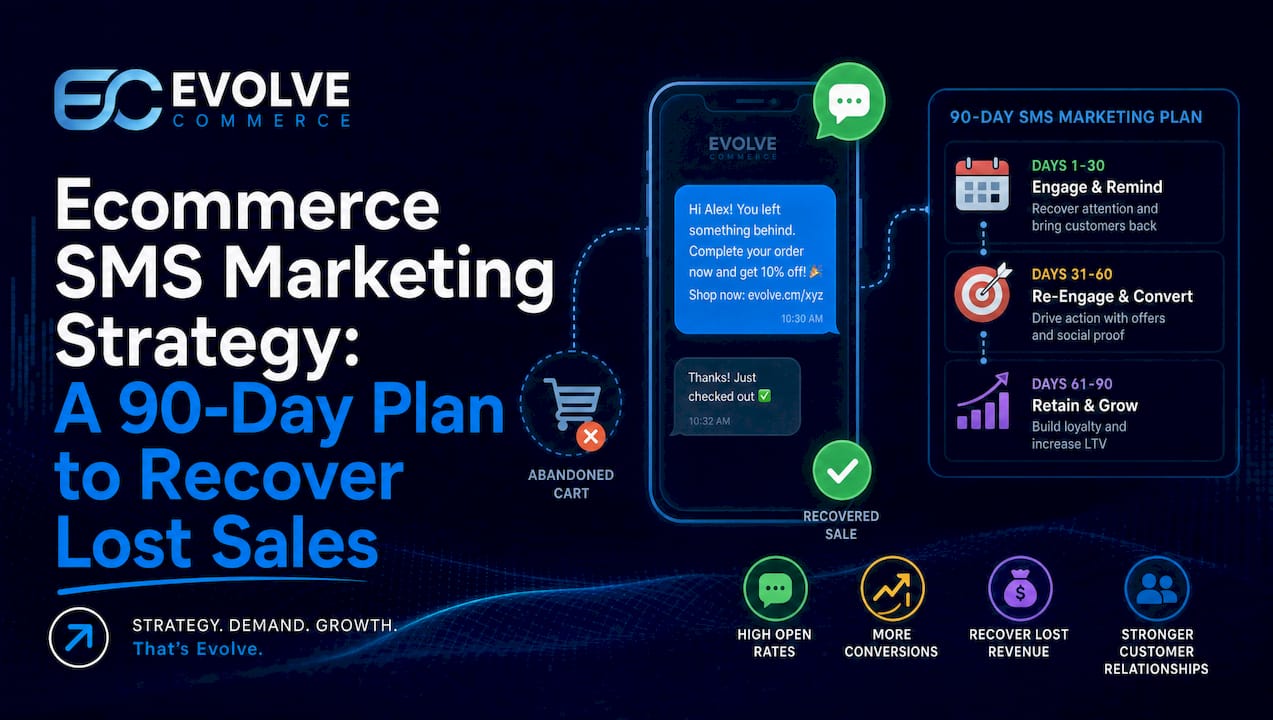
- What does a 30/60/90-day SMS rollout look like?
- What actually separates a good SMS programme from a mediocre one
- Managed SMS and full-funnel growth with Evolve Commerce
- Sources
- FAQ
Why SMS marketing works for ecommerce: the benefits and benchmarks
SMS earns its place in the budget because people actually read it. Text messages sit in the same inbox as messages from friends and family, so open rates dwarf email, and the decision to act happens in seconds rather than over several email visits. Klaviyo’s research with Recharge found that a strong majority of consumers are willing to receive a text from a brand at least once a week, and that willingness translates into purchases that happen sooner than they otherwise would.
Statistic Callout: Nearly three-quarters of consumers say they will accept a weekly text from a brand, and SMS measurably shortens the time between “I want this” and “I bought this,” according to Klaviyo’s SMS research.
That speed is the real advantage. Email is built for browsing and consideration; SMS is built for a decision that needs making right now. A flash sale, a restock alert, or a cart reminder lands on a screen the customer is already holding, which is why SMS tends to outperform email on time-sensitive offers and underperform it on anything that benefits from images, storytelling, or a longer pitch. Save your product education and brand narrative for email; save your urgency for text.
Mobile marketing as a category succeeds because it reaches people in real time and targets behaviour rather than broad demographics, cutting acquisition waste that plagues paid social. SMS is the sharpest edge of that category, but it carries sharper risks too. A poorly maintained list, vague consent records, or a frequency that annoys subscribers will spike opt-outs and can get your sending number flagged by carriers. The upside is real, but only for brands willing to protect list quality as carefully as they protect revenue.

What are the core SMS campaign types for ecommerce?
Every SMS programme worth running is built from a handful of campaign types, each with a distinct job and its own consent rules. Get the categories right and everything else, timing, copy, segmentation, becomes easier to plan.
- Promotional campaigns and flash sales. These are your revenue spikes: seasonal sales, limited-time discounts, new drops. Keep the cadence to only a few sends per week at most, lead with the offer in the first line, and put a deadline in every message (such as “Ends midnight” rather than just “Sale on now”). Overuse burns out a list faster than any other mistake in SMS.
- Abandoned-cart flows. With about 70% of online carts abandoned according to Baymard Institute, this is the highest-leverage automation you can build. A first text 30 to 60 minutes after abandonment (“Still thinking it over? Your cart’s saved”) followed by a second message with a modest incentive 24 hours later typically recovers more revenue than any single promotional blast.
- Transactional messages. Shipping confirmations, delivery updates, and order receipts fall under a different consent bucket than marketing texts. Customers expect these regardless of whether they opted into promotions, and mixing the two, sending a discount code inside a shipping notification, muddies your consent records and irritates subscribers who only agreed to service updates.
- Replenishment and back-in-stock alerts. For consumable or seasonal products, a well-timed “running low?” text tied to typical repurchase windows drives some of the most predictable revenue in the whole programme. Back-in-stock texts convert unusually well because the subscriber already showed intent by signing up to be notified.
- VIP and exclusive-access campaigns. Reserve early access, private sales, or loyalty perks for your highest-value segment. This is where SMS earns loyalty rather than just clicks, and it is far less likely to trigger unsubscribes than blanket discounting.
- Two-way SMS. Order status questions, size or fit queries, and simple customer service resolved by reply text reduce support tickets and, done well, turn a transactional channel into a relationship one. Not every platform supports it well, but for brands with a distinct customer voice it is worth the setup effort.
The pattern across all six: match the message type to the consent the customer actually gave, and match the tone to the urgency of the moment.
How do you build an SMS list with proper consent?
List growth in SMS is unlike email, because the legal bar for consent is higher and the tolerance for sloppy opt-in is lower. Get this wrong and you will pay for it in complaints, opt-outs, and, in the worst cases, carrier penalties.
- Checkout opt-in. A clearly labelled checkbox at checkout, unchecked by default, is the highest-quality source because the customer is already a proven buyer.
- On-site pop-ups and forms. Time these to intent, exit intent or after meaningful browsing, rather than firing them the second someone lands on the homepage.
- Email-to-SMS prompts. Ask existing email subscribers to add their number for a specific benefit, such as early sale access, rather than a generic “join our list.”
- In-store or QR sign-up. Retailers with physical locations can bridge the gap with a QR code at the till linked to a local SEO rank tracker and a mobile-first sign-up page.
The incentive matters as much as the mechanism. Exclusive access, early sale entry, a members-only drop, tends to attract subscribers who stay engaged because the value keeps recurring rather than expiring after one use, a pattern supported by Klaviyo’s own list-growth research.
Keep marketing consent and transactional consent as separate records in your platform, not a single “subscribed” flag. A customer who agrees to shipping alerts has not agreed to promotional texts, and treating those as one bucket is one of the fastest ways to generate complaints. Mobile marketing carries real privacy obligations, and a documented timestamp, source, and consent type for every subscriber is your protection if that consent is ever challenged.
Pro Tip: Put the unsubscribe instruction in the first message a new subscriber receives, not buried three campaigns later. Subscribers who know they can leave easily are more likely to stay, and a visible exit option is one of the simplest ways to keep opt-out rates low.
Which integrations and automations make SMS scale?
SMS becomes a real revenue channel only when it is wired into the same data as the rest of your stack. A platform sending texts off a static list, disconnected from live order and inventory data, will always lag behind one that reacts to what a customer just did.
- Connect order, inventory, and profile data first. Your messaging platform needs to know what someone bought, what is back in stock, and what is sitting in their cart in near real time. Without that pipe, every automation below is guesswork.
- Prioritise four automations before anything fancier. A welcome series for new subscribers, an abandoned-cart sequence, shipping and delivery updates, and post-purchase review requests cover most of the revenue and retention upside available from automation, and each can run largely untouched once configured.
- Map your existing ecommerce stack rather than forcing a new one. Whether you run on Shopify, WooCommerce, or a native CRM, the requirement is the same: order status, customer profile, and product catalogue data need to flow into your SMS platform, tools like Klaviyo are built around exactly this kind of two-way sync, so the flow needs to work in both directions, not just outbound sends.
- Test before you trust an automation. Place test orders, abandon test carts, and check that triggers fire once and only once. Duplicate sends, a customer getting the same cart reminder twice, are one of the fastest ways to generate unsubscribes.
- Monitor for silent failures. A broken trigger does not announce itself; it just stops sending. Build a simple weekly check on send volume against expected order and cart-abandon volume so a dead automation gets caught in days, not months.
Coordination with email matters just as much as the plumbing. Braze’s mobile marketing guidance makes the case plainly: SMS should carry the urgent, time-sensitive message, while email carries the richer story, so the two channels reinforce rather than duplicate each other. Send the same offer through both on the same morning and you have not doubled your reach, you have just annoyed the subscriber twice.
How does personalisation improve SMS conversion rates?
Segmentation is where SMS ROI is won or lost, because the format leaves no room for a generic message to earn its place. A text that could have gone to anyone gets ignored by everyone.
- New buyers benefit from a welcome sequence introducing your brand voice and setting expectations for send frequency.
- Lapsed customers, those quiet for 60 or 90 days, respond better to a “we miss you” message paired with a specific reason to come back than to a discount alone.
- High-LTV customers should see VIP and early-access campaigns before anyone else, reinforcing that their spend earns something tangible.
- Cart abandoners need urgency and product-specific copy referencing the actual item left behind, not a generic reminder.
Within the message itself, dynamic content (the actual product name, the actual discount tied to that customer’s history) consistently outperforms a static token like a first name alone. Test this directly: run an A/B split where one segment gets a generic “your cart is waiting” and the other gets the specific product name and price, then compare click-through and conversion side by side. Most brands see the specific version win decisively.
The line not to cross is over-personalisation that feels like surveillance. Referencing a browsing session from three days ago, or naming a specific page visit, reads as intrusive rather than helpful. Stick to purchase history and cart contents, the data a customer expects you to have, rather than granular behavioural tracking that makes the message feel watched rather than relevant.
What KPIs and benchmarks should you track for SMS?
Four metrics carry most of the signal in an SMS programme, and tracking them consistently matters more than chasing a perfect attribution model on day one.
| Metric | What it tells you | Where to focus first |
|---|---|---|
| Click-through rate | Whether the message and offer are landing | Test copy and send time before anything else |
| Conversion rate | Whether clicks turn into completed orders | Check landing page speed and mobile checkout friction |
| Revenue per recipient | The real financial value of each send | Compare across campaign types to find your best performers |
| Unsubscribe rate | Whether frequency or relevance is off | Flag any spike immediately, it is an early warning, not just a vanity metric |
On attribution, last-touch reporting will overstate SMS in some cases and understate it in others, since a customer who received a text but bought a day later through a different device rarely gets credited cleanly. Assisted-conversion reporting, layered on top of last-touch, gives a fuller picture, and integrating SMS data with your analytics stack rather than reading it in isolation is what most mature programmes eventually build toward. A dashboard like Evolve Commerce’s AdWize platform approaches this by pairing server-side attribution with performance insight across every paid and lifecycle channel, so SMS revenue is not sitting in its own silo disconnected from the rest of your marketing spend.
Set internal targets from your own baseline in the first 90 days rather than importing a competitor’s benchmark, and review performance weekly for the first quarter before dropping to a monthly cadence once the programme stabilises.
What does a 30/60/90-day SMS rollout look like?
A phased rollout keeps the programme from collapsing under its own ambition in month one. Prioritise in this order:
- Day one priorities. Lock down consent collection and record-keeping, launch a basic welcome message, and turn on the abandoned-cart automation before anything else, this single flow tends to prove the channel’s value fastest.
- First 30 days. Split your list into two or three basic segments, build a simple monthly promotional calendar, and run your first A/B test on send timing or copy length.
- Days 60 to 90. Layer in replenishment and VIP flows, connect assisted-conversion attribution, and audit your automations for duplicate or broken triggers now that volume has grown.
- Ongoing governance. Assign one person as compliance owner, set a hard cap on weekly sends per subscriber, and review unsubscribe trends monthly rather than waiting for a complaint to surface a problem.
Pro Tip: Resist the urge to launch every campaign type in week one. A brand that nails the welcome series and abandoned-cart flow first, then adds complexity gradually, will out-earn a brand that launches five automations at once and has to untangle which one is misfiring.
What actually separates a good SMS programme from a mediocre one
Most guides treat SMS as a standalone tactic: pick a platform, write some flows, watch the revenue come in. That underestimates how much SMS depends on everything around it. A cart-recovery text only works if the checkout it links to loads fast on mobile. A VIP campaign only works if the segment behind it is built from accurate purchase data. SMS amplifies whatever is already true about your funnel, good or bad, rather than fixing it on its own.

The brands generating outsized results from SMS are rarely running it in isolation. They are pairing it with paid media that feeds the list, creative that gives the message something worth clicking, and email that carries the fuller story SMS cannot. Evolve Commerce has seen this play out directly across client work spanning creative production and full-funnel campaigns, where clients have posted annual revenue growth between 100 – 400% once channels stopped operating as separate silos.
That is the honest answer to the build-versus-buy question. A lean team with one dedicated owner and a clear roadmap can run SMS well in-house. A brand juggling SMS, paid social, email, and creative production across a small team usually benefits from a specialist partner who can keep those channels talking to each other, because the ceiling on SMS performance is set by the weakest connected channel, not by SMS itself.
— Evolve Commerce
Managed SMS and full-funnel growth with Evolve Commerce
Evolve Commerce is the alternative to juggling five disconnected tools and a part-time SMS owner: one team manages your text campaigns alongside the paid media, creative, and email that feed them, so the abandoned-cart flow you build this month is actually informed by the ad campaign driving traffic to it.
That connection is the whole point. Evolve Commerce’s lifecycle marketing service builds and optimises SMS and email flows on platforms like Klaviyo, backed by the AdWize analytics dashboard for server-side attribution, so you can see exactly what a text campaign contributed rather than guessing from last-touch numbers alone. Brands including Illuminated Mirrors, Master Chef, and Tea.xyz have worked with Evolve Commerce across paid media, creative, and lifecycle channels to build the kind of connected system this article has been describing throughout.
If your SMS programme has stalled at a welcome series and the occasional discount blast, that is usually a sign the surrounding channels need attention too. Get in touch with Evolve Commerce to talk through what a managed, full-funnel approach could look like for your brand.
Sources
The claims in this guide draw on a small set of primary sources worth bookmarking directly. Klaviyo’s ecommerce SMS marketing guide covers consumer willingness to receive texts and purchase-acceleration data in more depth. Baymard Institute’s cart abandonment research is the standard reference for abandonment benchmarks across ecommerce. Investopedia’s mobile marketing overview explains the privacy and consent considerations that apply across SMS and app-based channels. Braze’s mobile marketing resource sets out how SMS should coordinate with push and email in a connected customer journey.
- Baymard Institute — cart abandonment rate
- Mobile marketing (Investopedia)
- Mobile marketing: How to engage customers across apps, SMS, and push — Braze
FAQ
What is SMS marketing for ecommerce?
SMS marketing is the practice of sending permission-based text messages, promotions, cart reminders, shipping updates, to customers who have opted in, using their mobile number as a direct, real-time channel to drive purchases.
Is SMS marketing legal?
Yes, provided you collect clear, documented consent before sending marketing texts and give subscribers an easy way to opt out, requirements that sit at the centre of mobile marketing’s privacy obligations; rules vary by country, so check the requirements that apply in your market before launching.
How do I unsubscribe from SMS marketing?
Reply “STOP” to the text, or use the opt-out instruction included in the message, most compliant platforms process this automatically and confirm the unsubscribe within seconds.
How much does SMS marketing cost for an ecommerce brand?
Costs typically combine a platform subscription fee with a per-message sending charge, so total spend scales with list size and send frequency rather than being a single flat rate; brands running SMS as part of a managed lifecycle programme, such as through Evolve Commerce, typically fold this into a broader retainer covering strategy, copy, and automation build alongside the sending cost itself.
How is SMS marketing different from email marketing for ecommerce?
SMS gets read faster and drives quicker decisions, making it better for urgent, time-sensitive offers, while email suits longer storytelling and product education; the two work best run together rather than as competing channels, as Braze’s mobile marketing guidance recommends.