
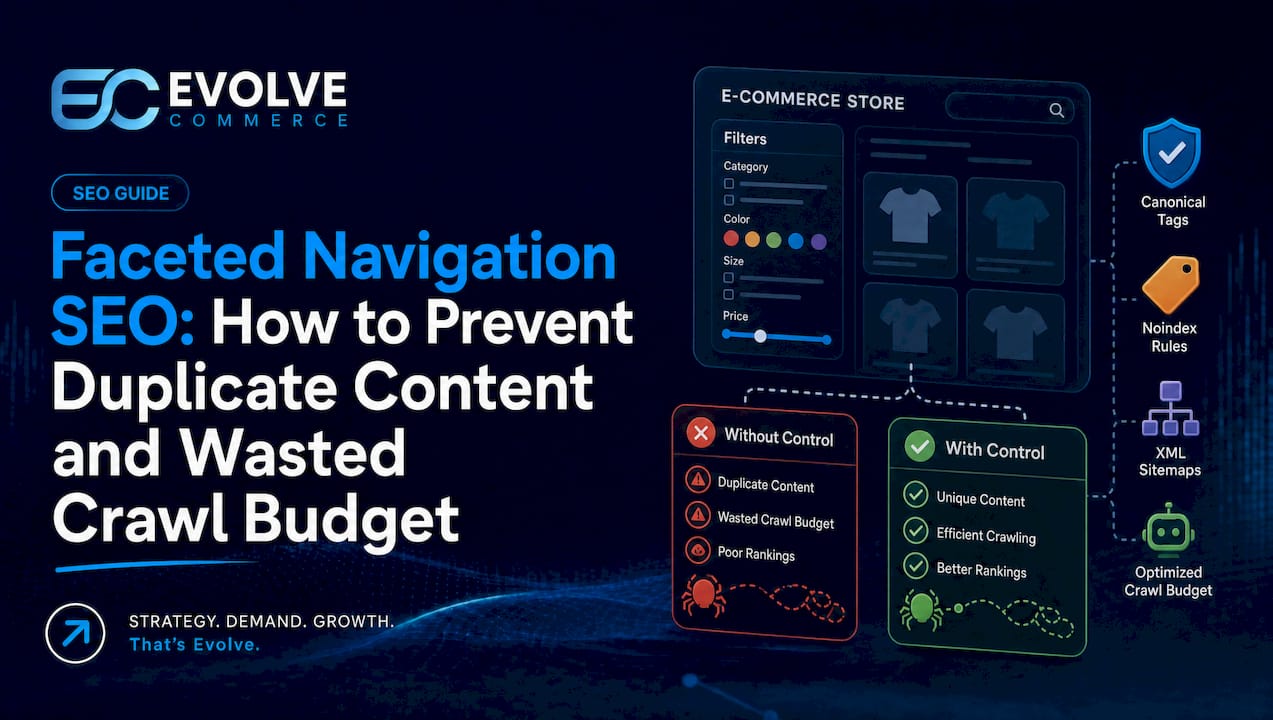
Faceted navigation is a genuine asset for shoppers, but left unmanaged it multiplies URLs faster than your catalogue grows, and that mismatch is what damages rankings. If your indexed URL count runs far ahead of your product count, run an inventory audit this week. The fix, broadly, is to limit which facet combinations get indexed, canonicalise the rest, apply noindex selectively, and only touch robots.txt once canonical signals have settled.
- Only index a limited number of high-demand, stable facet combinations that have significant search traffic and conversion potential to prevent index bloat and cannibalization.
- Use canonical tags for duplicate facet URLs and noindex for pages meant to be removed from search results, ensuring signals are settled before applying robots.txt disallow rules.
- Conduct thorough audits through site search, Google Search Console, server logs, and crawling tools to identify problematic URLs and prioritize fixes based on business impact.
- Structure URL parameters consistently and restrict parameter ordering at the platform level to avoid multiplying identical URLs and causing duplicate content issues.
- Treat facet pages as proper landing pages only when they meet demand, have sufficient inventory stability, and reflect real commercial value, enhancing both UX and SEO performance.
Table of Contents
- What is faceted navigation and how does it create SEO problems?
- What SEO problems does faceted navigation commonly cause?
- How do you audit faceted navigation before making changes?
- Which technical fixes should you use, and when?
- Which facets should actually become indexable landing pages?
- What order should you make these changes in?
- How does Evolve Commerce approach faceted navigation SEO?
- How does faceted navigation affect site architecture and internal linking?
- How does faceted navigation affect user experience and search signals?
- Does structured data help with faceted navigation pages?
- What do successful faceted navigation strategies look like in practice?
- Lessons from real faceted navigation projects
- How Evolve Commerce fixes faceted navigation for growing ecommerce brands
- Sources
- FAQ
What is faceted navigation and how does it create SEO problems?
Faceted navigation is the filter and sort system that lets shoppers narrow a category page by attributes like colour, size, brand, price, or material. Every time a shopper ticks “blue”, “size 9”, and “under £50”, the platform typically reflects that combination in the URL, whether through a query string (?colour=blue&size=9), a path segment (/blue/size-9/), a URL fragment, or an AJAX call that never touches the address bar at all.
The distinction that matters most for faceted search optimisation is between discovery facets and refinement or utility facets. Discovery facets, such as brand, category, or material, tend to attract genuine search demand: shoppers type “blue running shoes” into Google often enough that a landing page built around that combination can earn traffic. Refinement facets, such as sort order, page size, or “in stock only,” serve almost no search demand. Nobody searches for “products sorted by price descending,” yet many platforms happily generate a crawlable URL for exactly that.
- Discovery facets: brand, category, colour, material, gender, use case
- Refinement/utility facets: sort order, items per page, view type, in stock toggle, currency
- Hybrid facets: price range and size sit somewhere between the two, depending on your catalogue and search demand
Parameter order is where most sites lose control without realising it. If your platform generates ?colour=blue&size=9 on one page and ?size=9&colour=blue on another, that’s two distinct URLs serving identical content. Multiply that by every filter combination a shopper can select, and an average-sized catalogue can easily generate a very large number of crawlable permutations. Google’s own guidance on faceted navigation recommends a standard & separator and a consistent, logical parameter order specifically to stop this kind of duplication before it starts. Get that ordering right at the platform level, and you remove a huge share of the problem before you write a single robots.txt rule.
What SEO problems does faceted navigation commonly cause?
Four problems recur across almost every ecommerce audit Evolve Commerce has looked at, and they compound each other.
- Duplicate content and cannibalisation. A “blue shoes” facet and a “shoes, colour: blue” facet often serve near-identical product grids with different URLs and no clear signal to Google about which one should rank. Search engines then split ranking signals between them, and neither performs as well as a single consolidated page would.
- Index bloat. Check Google Search Console’s Pages report and you’ll frequently find indexed URL counts many multiples higher than the actual product count. That’s the clearest tell that facets are being indexed uncontrolled, and it dilutes the authority of the pages you actually want to rank.
- Crawl budget waste. Every crawler visit spent on
?sort=price_desc&page=7is a visit not spent on a new product page or a genuinely valuable category. Internal links pointing to every facet combination make this worse, because they tell crawlers those low-value URLs deserve attention. - Thin or empty pages. A facet combination with zero matching products (say, “red winter coats” in a summer-only catalogue) produces an empty grid that should never sit at a 200 status code. Suppress it or return a 404.
Search Engine Journal frames the fix as a layered policy: inventory what exists, decide deliberately which combinations deserve indexation, and suppress everything else through canonicals, noindex, or robots.txt rather than hoping the crawler sorts it out.
Diluted link equity deserves a specific mention. Every internal link your platform generates to a facet URL passes a slice of authority away from your money pages. On a large catalogue, that can mean thousands of internal links spread across parameter noise instead of concentrated on the category and product pages driving revenue.
How do you audit faceted navigation before making changes?
Start with the cheapest checks and escalate only where the data justifies it, using insights from search query performance to guide your forensic examination.
- Site search first. Run
site:yourdomain.com inurl:filteror similar queries against your own parameter patterns. If Google is indexing hundreds of results for patterns you never intended to rank, you’ve found your starting point in minutes. - Google Search Console. Work through Coverage (or the Pages report in newer GSC), then Performance, filtering by page. Look for facet URLs receiving impressions with near-zero clicks, and cross-reference against the “Indexed, not submitted in sitemap” category, which frequently flags rogue facet URLs Google found through internal links rather than your sitemap.
- Log-file analysis. This is the step most audits skip, and it’s the one that actually quantifies waste. Pull raw server logs and filter by crawler user-agent to see exactly how often Googlebot hits parameterised URLs versus your actual product and category pages. If a significant proportion of crawl hits land on filter combinations, that’s crawl budget you’re not spending on anything that earns revenue.
- Crawl with an SEO tool. A site crawler will enumerate the parameter permutations your platform is actually generating, group them by template, and surface duplicate title tags and meta descriptions at scale. Ahrefs recommends exactly this combination of site search, GSC and crawler tools as the standard audit approach, precisely because each method catches something the others miss.
- Prioritise by business impact, not volume. A facet template generating 50,000 duplicate URLs but zero impressions matters less than one generating 500 URLs with real search demand and conversions attached.
Pro Tip: Before you touch a single technical control, export your full URL inventory and tag each pattern by facet type. Teams that skip this step almost always end up applying the same fix to fundamentally different problems, which is how a robots.txt rule ends up accidentally blocking a page that was actually earning traffic.
Which technical fixes should you use, and when?
There’s no single correct answer here. Canonical tags, robots.txt, noindex, and 404s each solve a different version of the problem, and using the wrong one for the wrong situation is the most common mistake in faceted search optimisation.
Canonical tags work best when facet combinations are genuine duplicates with a clear preferred version. A canonical tag on ?size=9&colour=blue pointing to ?colour=blue&size=9 consolidates ranking signals over time. It’s a hint, not a directive; Google can and does ignore canonicals it disagrees with, so treat it as the first line of defence rather than a guarantee.
Robots.txt disallow rules stop crawlers from requesting URLs matching a pattern, which is genuinely effective for pure noise parameters like sort order or session IDs. The critical caveat: a page blocked in robots.txt can still get indexed if Google finds it linked elsewhere, just without content Google can evaluate, and Google is explicit that a blocked page cannot reveal an on-page noindex tag, because the crawler never reaches the page to read it.

Noindex meta tags suit pages you want removed from the index while still allowing crawlers to follow the links on them, which matters for link discovery deeper into your catalogue. Never combine noindex with a robots.txt block on the same URL; that pairing simply keeps a low-value page around forever.
404 or 410 status codes are correct for facet combinations that structurally cannot return results, such as an out-of-season size and colour pairing. Don’t let those render as soft-404 200-status pages with an empty grid.
AJAX and the History API let you update the visible product grid without minting a new crawlable URL at all, which is often the cleanest fix for pure refinement facets that will never carry search demand.
| Method | Best for | Key caveat |
|---|---|---|
| Canonical tag | Genuine duplicate facet combinations | A hint Google may override |
| Robots.txt disallow | Pure noise parameters (sort, session ID) | Blocked pages can’t reveal on-page noindex |
| Noindex meta tag | Pages to deindex but keep crawlable | Never pair with a robots.txt block on the same URL |
| 404/410 status | Impossible or zero-result combinations | Avoid soft-404s at 200 status |
| AJAX/History API | Refinement facets with no search demand | Doesn’t help facets that do have demand |
On parameter formatting, keep it boring and consistent. Use the standard key=value pattern joined by &, and lock parameter order at the platform level, whether alphabetical or by a fixed logical sequence. Google’s faceted navigation guidance and independent technical audits both point to the same root cause behind most duplicate-permutation problems: inconsistent parameter ordering that multiplies effectively identical URLs. A nuanced read on canonical versus robots.txt is worth keeping in mind too: canonicals consolidate signals gradually, while robots.txt physically stops crawling but offers no guarantee the page ever leaves the index if it’s already there.
Which facets should actually become indexable landing pages?
Not every facet deserves a shot at ranking, and treating them all equally is how index bloat happens in the first place. Run each candidate combination through four criteria before deciding.
- Measurable search demand. Pull query and impression data from Search Console and keyword tools. “Waterproof hiking boots” has demand; “boots, sorted by newest” does not.
- Sufficient result set. A facet page showing three products rarely satisfies a searcher or justifies a dedicated landing page. Set a reasonable minimum product threshold before a combination qualifies as index-worthy.
- Inventory stability. A facet page that swings between 40 products and zero across a season is a poor landing page candidate, because inventory volatility undermines the consistency search engines reward over time.
- Commercial value. Prioritise combinations tied to categorize with real margin or conversion history, not just traffic potential.
Once a facet clears those bars, treat it as a proper landing page rather than a filtered afterthought. That means a unique title tag and H1 (not an auto-generated string of selected filters), a meaningful amount of genuine editorial copy explaining the category, internal links pointing to it from relevant category and blog pages, and inclusion in your XML sitemap. Platforms and playbooks covering faceted navigation for retailers consistently flag this on-page work as the difference between a facet page that ranks and one that Google quietly treats as a thin duplicate.
Build this into a living, approved list rather than a one-off decision. Review query and impression data quarterly, add newly qualifying combinations, and retire ones that lose demand or inventory stability. For your strongest performers, use clean path-based URLs, something like /running-shoes/blue/ rather than a query string, and keep them in the canonical sitemap so they read unambiguously as intentional pages rather than parameter noise that happened to get indexed.
What order should you make these changes in?
Sequencing is where most in-house teams go wrong, and it’s rarely about picking the wrong tool. It’s applying the right tools in the wrong order.
- Step one: inventory. Know exactly what facet URLs exist, at what volume, and how each is currently controlled (or isn’t).
- Step two: canonicalisation. Add canonical tags pointing duplicate combinations to their preferred version, and add noindex to combinations you want out of the index but still crawlable.
- Step three: wait and monitor recrawl. Give Google time to revisit affected URLs and process the new signals before you add any crawl blocks.
- Step four: robots.txt disallows. Only once canonical and noindex signals have settled should you disallow pure noise parameter patterns in robots.txt.
The reason for that order comes straight back to the caveat in Google’s own documentation: a blocked page cannot reveal an on-page noindex tag, because the crawler never gets far enough to read it. Block too early and you can strand URLs in the index indefinitely, since Google can no longer crawl them to confirm they should be removed. Sequencing this correctly, canonicals and noindex first, then a monitored recrawl, then robots.txt, is a frequently cited root cause of lingering index problems when teams get it backwards.
Expect a monitoring window measured in weeks, not days, before crawl stats and indexed-URL counts in Search Console shift meaningfully. If indexed counts haven’t moved after a full monitoring cycle, revisit whether your canonical signals are actually being respected before reaching for robots.txt.
How does Evolve Commerce approach faceted navigation SEO?
Evolve Commerce treats faceted navigation as a data decision before it’s ever a technical one. Every engagement starts with a full URL inventory mapped against actual catalogue size, because that gap tells you more about the scale of the problem than any single Search Console report. From there, selective indexation follows the same demand-and-stability framework covered above, rolled out in the canonicals-first sequence that protects existing rankings while cleanup happens.
Clients working with Evolve Commerce on SEO strategy engagements have reported significant growth, with brands including Light Mirrors, F1 Eyewear and BBQ Grill Pods are among those who have scaled through this kind of full-funnel technical and growth work. Facet decisions don’t happen in isolation, either; ongoing monitoring through the Adwize analytics platform tracks indexed-URL trends and crawl behaviour alongside revenue data, so facet strategy adjusts as the catalogue and search demand shift, not just once at launch.
How does faceted navigation affect site architecture and internal linking?
Facets sit inside your category structure, but they behave more like an exponential multiplier on it than a simple extension. A single category page with five filter types, each offering four or five options, can generate thousands of theoretical URL combinations branching off one node in your site tree. Left unmanaged, your internal linking structure ends up flatter and messier than it looks on a sitemap diagram, because crawlers reach far more low-value nodes than intended, each one siphoning a sliver of link equity away from the pages you actually want ranking.
The fix is architectural, not just technical. Treat your approved indexable facet templates as first-class nodes in your site structure, linked deliberately from category pages, navigation menus, and relevant blog content, exactly the way you’d link to any other landing page. Everything else, the refinement facets and long-tail combinations, should stay reachable for users through on-page filtering but invisible to crawlers as a distinct linked path. That distinction, between what a shopper can click and what a crawler is invited to follow, is the core architectural discipline faceted navigation demands.
Getting this right also protects your crawl depth. A well-structured facet hierarchy keeps your highest-value pages within two or three clicks of the homepage, while an unmanaged one buries valuable long-tail combinations under layers of noise parameters that never needed a URL in the first place.
How does faceted navigation affect user experience and search signals?
Shoppers genuinely benefit from good filtering. It shortens the path from browsing to buying, and a well-designed facet system is one of the strongest conversion tools an ecommerce category page has. The tension is that the same feature built purely for UX, with no thought given to which combinations should be crawlable, is what creates the SEO problems covered earlier in this guide.
Behavioural signals sit at the intersection of both. When a shopper lands on a facet page via search and the result set matches what they expected, engagement metrics like time on page and pages per session tend to hold up well. When a facet page is indexed almost by accident, thin, poorly titled, or returning near-duplicate content, bounce rates climb and dwell time drops, and those signals feed back into how search engines evaluate the page over time.
The practical implication is that user experience and indexation decisions need to be made together, not handed to separate teams working from separate briefs. A facet combination can be excellent for UX and still wrong to index, and a combination worth indexing needs the same on-page quality bar, unique copy, clear titling, sensible internal links, that any other landing page would need to earn genuine engagement rather than a quick bounce back to search.
Does structured data help with faceted navigation pages?
Schema markup earns its place on the facet pages you’ve deliberately chosen to index, not across every parameter permutation your platform can generate. For approved facet landing pages, ItemList or CollectionPage structured data, paired with Product schema on the items themselves, helps search engines understand the page as a genuine curated collection rather than a machine-generated filter result.
Applying structured data indiscriminately across every facet combination creates its own problem: thousands of near-identical schema blocks describing near-identical product sets, which reinforces the duplicate content signal you’re trying to eliminate rather than solving it. Reserve rich markup for the templates that have cleared your indexation criteria, the ones with genuine search demand, editorial copy, and a stable product set, and leave refinement facets without it entirely.
Breadcrumb structured data is worth a specific mention, since it works well across both indexed and non-indexed facet pages. It reinforces your site hierarchy for any page a crawler does encounter, indexed or not, and costs nothing in terms of duplicate-content risk because it describes navigation position rather than product content.
What do successful faceted navigation strategies look like in practice?
The ecommerce sites that handle this well share a pattern rather than a single trick. They index a deliberately narrow set of high-demand facet combinations, most often single-attribute pages like brand or top-level category, dressed as proper landing pages with unique copy and clean URLs, while keeping multi-filter combinations and pure refinement facets out of the index entirely.
Large fashion and homeware retailers, for instance, commonly index “brand plus category” combinations (a specific label’s footwear range, say) because that pairing consistently shows measurable search demand, while leaving three-and-four-filter combinations (brand, colour, size, and price band stacked together) unindexed, reachable only through on-page filtering. The pattern holds because those deeper combinations rarely have standalone search volume to justify a landing page, and indexing them just multiplies duplicate content risk for no ranking benefit.
The common thread across these approaches isn’t a specific plugin or platform feature. It’s the discipline of treating indexation as a deliberate editorial decision rather than a default outcome of how the filtering system happens to generate URLs, paired with the sequencing discipline covered earlier: canonical and noindex signals settled first, robots.txt reserved for genuine noise parameters once that settling has happened.
Lessons from real faceted navigation projects
Three lessons come up on nearly every project. First, inventory discipline beats cleverness. Teams that map their real URL count against catalogue size before choosing a fix waste far less time than those who jump straight to robots.txt. Second, sequencing protects you: canonicals and noindex first, then a monitored wait, then crawl blocks. Third, blanket disallow rules almost always block something worth keeping.
The recurring friction isn’t technical. It’s misalignment between developers who see facets as a UX feature and SEOs who see them as an indexation risk. Fixing that means one shared, living list of approved facet templates that both teams sign off on. Start there: run the inventory audit this week, before the next platform update quietly generates another few thousand URLs you didn’t ask for.
— Evolve Commerce
How Evolve Commerce fixes faceted navigation for growing ecommerce brands
Evolve Commerce is the practical alternative to hiring separate freelancers for audit, implementation, and ongoing monitoring, three jobs that faceted navigation genuinely needs done together, not in isolation. Rather than handing you a one-off audit document and leaving the sequencing to your dev team, Evolve Commerce runs the full workflow: URL inventory, selective indexation strategy, canonical and noindex implementation, and a monitored robots.txt rollout timed to when the data says it’s safe.
Ongoing monitoring runs through the Adwize analytics platform, which tracks indexed-URL counts, crawl patterns and organic performance alongside the rest of your growth metrics, so facet decisions stay tied to revenue outcomes rather than sitting as a static fix that goes stale within a quarter. Brands including Hunter, Juicy Couture and FILA have worked with Evolve Commerce on exactly this kind of full-funnel technical and growth engagement. If your indexed URL count looks disconnected from your product count, get a technical SEO audit started and find out where the gap is actually coming from.
Sources
- Faceted navigation (Google Developers)
- Faceted Navigation: Best Practices For SEO (Search Engine Journal)
- Faceted Navigation: Definition, Examples & SEO Best Practices (Ahrefs)
FAQ
Should I use canonical tags or noindex for duplicate facets?
Use canonical tags when a facet combination is a genuine duplicate with one clear preferred version, and use noindex when you want a page removed from the index while keeping it crawlable for link discovery. They solve different problems and are often used together across different facet types on the same site.
When should I add robots.txt disallow rules for facets?
Only after canonical and noindex signals have settled and Google has had time to recrawl the affected URLs, typically a matter of weeks. Adding robots.txt too early can strand pages in the index because a blocked page cannot reveal an on-page noindex directive.
How many facet combinations should I allow to be indexed?
Only the ones that clear a demand, inventory, and stability bar, typically a small fraction of total possible combinations. Most sites end up indexing single-attribute facets like brand or top-level category and keeping multi-filter combinations out of the index entirely.
How long does it take to see results after fixing faceted navigation?
Expect changes in crawl stats and indexed-URL counts within a few weeks of implementing canonical and noindex signals, with ranking improvements on cleaned-up pages following as consolidation takes hold. Revisit the data if indexed counts haven’t shifted after a full monitoring cycle.
Can faceted navigation ever be good for SEO?
Yes, when a small set of high-demand facet combinations are deliberately turned into proper landing pages with unique copy, clean URLs and internal links. The goal isn’t eliminating faceted navigation, it’s controlling which parts of it search engines are allowed to index.